
The useful search is not “how do I purge Cloudflare.” It is why am I still the person who has to remember this. A cache purge after a site deploy is one boring example of a class: a known trigger, the same clicks, and a quiet failure if anyone skips a step. US small businesses run that class all week — inbound leads, reminders, missed calls — and it does not show up as a developer ticket. It shows up as “we’ll get it Monday.”
What is a repeatable ops task?
A repeatable ops task is work that fires from the same trigger and should always produce the same next steps. Form submitted. Appointment booked. Call missed. Site shipped. If a competent person would do the same eight things every time, you do not need a hero. You need a path.
Asana’s Anatomy of Work research (knowledge workers, not a census of US trades) still names the pattern honestly: a large share of the week is work about work — coordinating, re-entering, chasing — rather than the skilled job you hired for. Their 2023 index also reported that people estimated better processes could return on the order of several hours per week. Treat that as a signal, not a promise for your shop. The earlier Anatomy of Work PDF describes the same class of duplicated manual steps.
You do not automate judgment. You automate the stairs to the judgment.
Why do “quick” manual steps keep winning?
Because each one looks cheap. Typical failure modes:
- The same lead is typed into a form, then a sheet, then a phone
- Reminders go out only when someone remembers Friday
- After-hours inquiries sit until the inbox owner is back
- A website change is live, but a leftover click (purge, republish, “did you hit save?”) is still a person
None of those need a science project. They need an owner and a trigger. If two people might do it — or zero people might — you have a ritual, not operations.
What does the path look like instead of eight clicks?
Name four things. If you cannot, stop buying tools.
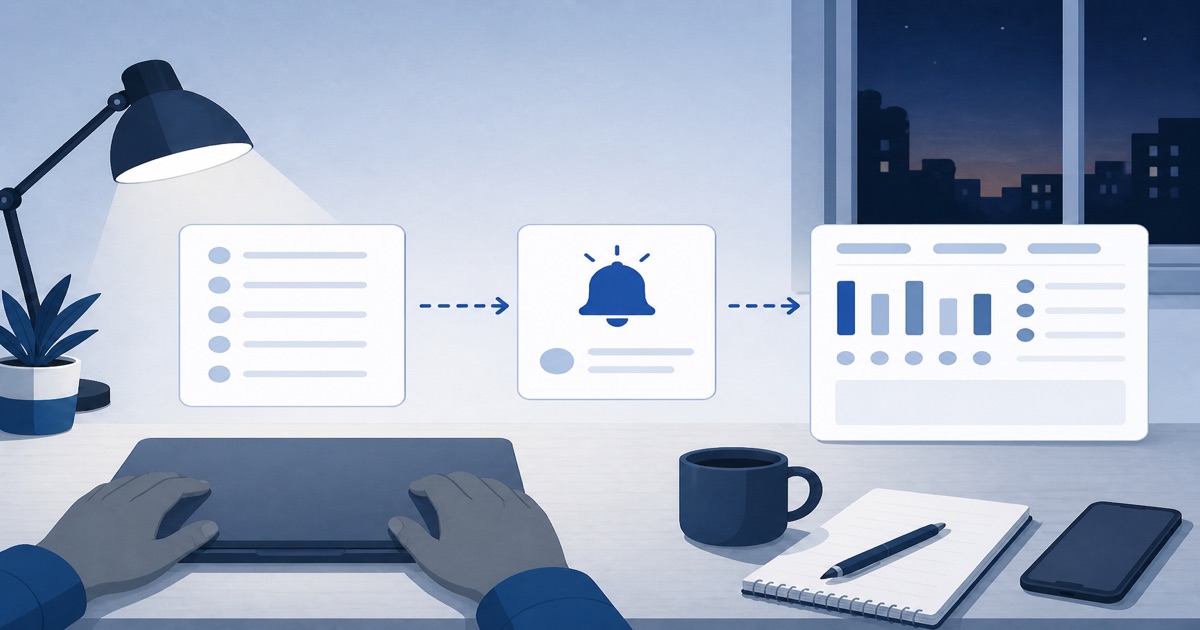
- Trigger — the event (form, booking, missed call, deploy)
- Record — one pipeline or sheet of truth
- Notify — a human who can act, with context
- Fallback — what happens if nobody claims it
On our own site, the “purge after publish” step is that pattern in miniature: the trigger is a real deploy, the action is mechanical, and skipping it leaves visitors on stale pages. Your Friday list is the same shape. The product names change; the gap does not.
For inbound work, that is Lead Intake Ops — capture, route, alert, follow-up — not a bigger ad budget. Reminder and missed-call loops are the same idea on Appointment Ops and Home Service Ops. Tooling can sit on apps you already pay for or a hosted layer — On your tools vs We host it.
What does “good” look like without fake ROI?
You should answer, in one screen:
- What fired, from where, and when
- Who was supposed to act
- Whether the path ran without a hero
If you cannot, automation will copy the mess faster. Clarity first. Then put the boring stairs on rails and keep them with monthly care.
Next step
If the pain is unanswered hand-raises, start with Lead Intake Ops. If the pain is no-shows, use Appointment Ops. Missed calls: Home Service Ops. When the leftover clicks live on the website itself, that is Site Care.