
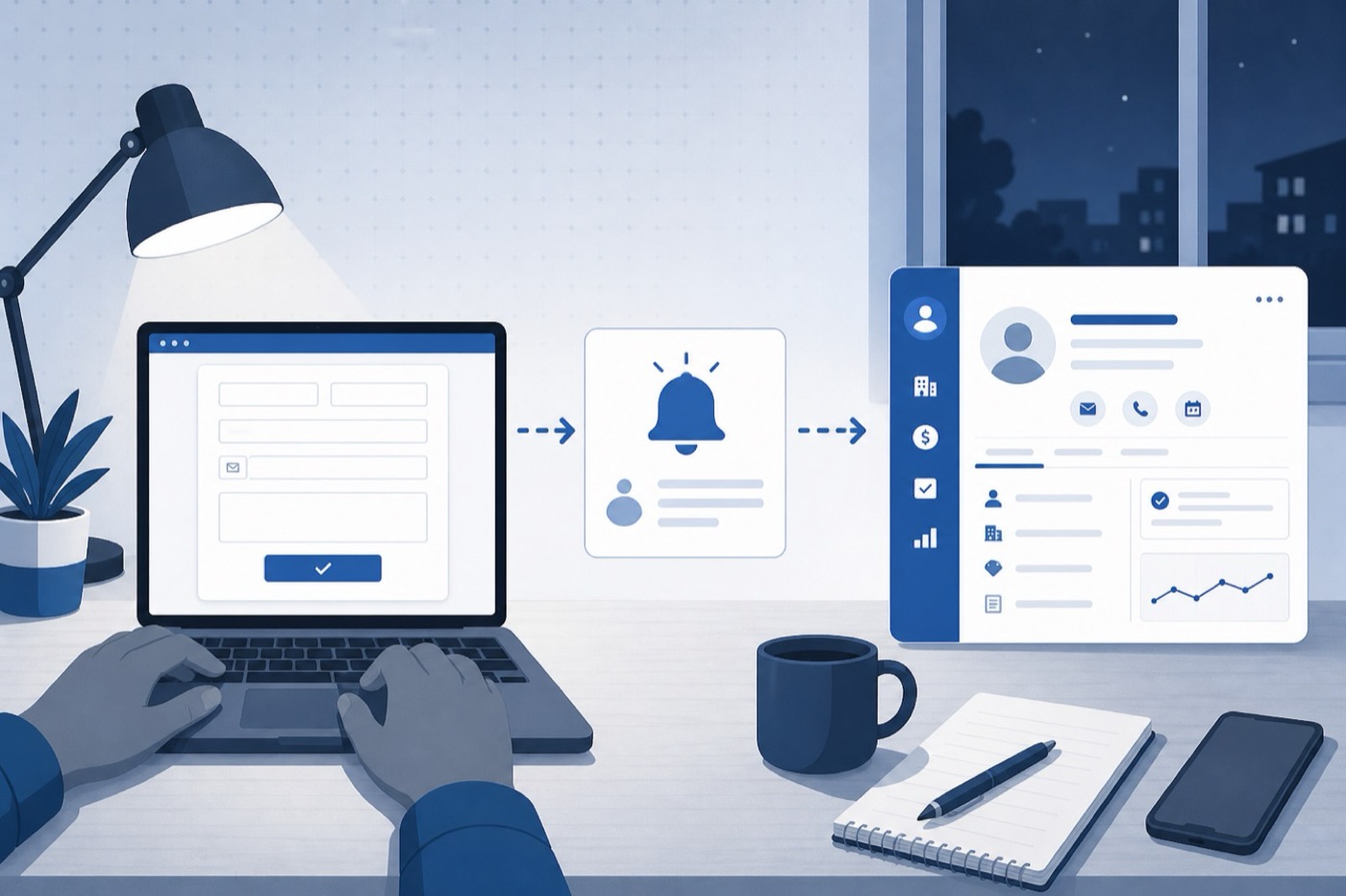
Most US small businesses do not lose leads because the ad was wrong. They lose them in the gap after submission — when the thank-you page fires and nobody owns the next minute. Fix that with one pipeline, an immediate owner alert, and a fallback if the lead goes unclaimed.
What is speed-to-lead?
Speed-to-lead is how fast a qualified human (or a clear next step) responds after someone raises their hand — form, chat, ad click-to-call, or email.
Published lead-response research (summarized in Harvard Business Review’s The Short Life of Online Sales Leads) shows contact and qualification rates fall sharply as minutes turn into hours. Exact percentages vary by study and vertical; the durable pattern is: minutes beat hours, and hours beat “we’ll get it tomorrow.”
You do not need a call center. You need a path that:
- Captures the lead in one place
- Notifies the right owner
- Starts a simple follow-up sequence if nobody answers
Why do form leads go cold overnight?
Because ownership is ambiguous. Typical failure modes:
- Form emails land in a shared inbox nobody owns after hours
- Ads and website forms write to different spreadsheets
- The “CRM” is a phone notes app
- Everyone assumes someone else replied
If two people might reply — or zero people might — you do not have intake. You have hope.
What does a practical lead intake path look like?
A durable Lead Intake setup usually looks like this:
- Normalize sources — website form, Facebook/Google lead ads, and inbound email aliases feed one pipeline
- Create or update a contact in your CRM or shared sheet of record
- Alert the on-call owner (SMS/Slack/email) with context, not just “new lead”
- Fallback — if no claim within N minutes, escalate or send a polite auto-ack with expectation-setting
- Log what happened so Monday morning isn’t archaeology
Tooling can be Zapier/Make on apps you already pay for, or a hosted middle layer we run — see our article on choosing On your tools vs We host it. Platform fees are usually pass-through; we do not hide that.
What does “good” look like without fake ROI claims?
You should be able to answer, in one screen:
- Who came in, from where, and when
- Who was notified
- Whether anyone responded
If you cannot answer those three, automation will not save you — clarity will. Automation then keeps the clarity from rotting.
Next step
If the pain is “leads sit unanswered,” the matching ScopedOps package is Lead Intake Ops — setup plus monthly care so the path stays running.